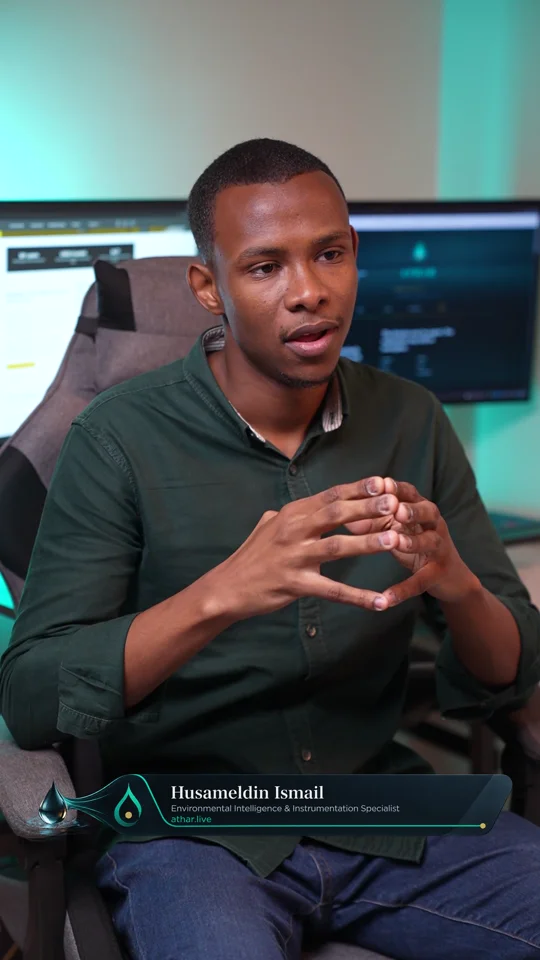
Husameldin Ismail · Environmental monitoring & instrumentation

From the instrument in the field to the decision made from the evidence.

An environmental change can become an operating, regulatory or financial problem.

A station can be online and sending measurements while the team is still unsure whether the data is trustworthy, what changed, or what action the evidence supports.

See the verified Record
Husameldin Ismail speaking about his work

The signal is only the beginning.

Watch

Building the system. Checking the evidence. Explaining the next step.

I help organisations build stronger monitoring networks, improve existing ones, solve reliability problems and turn environmental measurements into evidence that managers and technical teams can use.

My expertise covers sensors, stations and buoys, power, sending field data through telemetry and communications, deployment and commissioning, troubleshooting, and checking data quality through quality assurance and quality control (QA/QC).

My work includes coastal monitoring associated with Environment Agency – Abu Dhabi (EAD), industrial-discharge monitoring at Emirates Global Aluminium (EGA), and water-quality monitoring at Emaar Beachfront.

Across my documented record, I have directed up to seven technicians, coordinated priorities across up to 20 concurrent stations, and explained findings and next steps to clients.

Mechatronics Engineer certified by the Society of Engineers – UAE (SoE). My path from mechatronics and embedded systems through instrumentation and monitoring now shapes my work in environmental data interpretation and Environmental Intelligence.

Look at the work behind the description.

Real systems, bounded responsibility

The Record covers 30 stations and buoys across the UAE, Saudi Arabia and Qatar—not a claim that I deployed or led every system alone. The 95% data-availability figure is a target, not a guaranteed result.

Explore the verified Record

More than installing sensors

A programme starts with what needs to be known. Instruments, stations, power, communications and field checks must work together before the measurements can support a decision. That is the monitoring lifecycle.

Follow the monitoring lifecycle

When the first explanation is not enough

A replacement instrument did not end one fault. More solar power did not explain another. These Field Decisions show how checking alternatives changed the next step.

Explore the field decisions

Test the question before extending the claim

Study 01 explores low-cost air-quality measurements. It includes disclosed reconstructed or simulated data and is not regulatory monitoring. The Articles distinguish field experience from professional commentary.

Explore the StudiesRead Articles & Insights

Collecting data is only the beginning.

Understanding what changed means checking the measurements, the system and the environmental context, while keeping uncertainty and alternative explanations visible. This is the direction I describe as Environmental Intelligence.

ATHAR explores that connection. It is under development and validation, not a deployed service, a compliance authority or a replacement for professional judgement, calibrated instruments and QA/QC.

FIELD NOTES

Real instruments. Real problems.

A few practical lessons from sondes, ADCPs, loggers, telemetry and field systems.

Explore Field Notes →